The metanoias

Change the map. Change the center.

A guided walkthrough, in forty-two graphic novels, through the lives of remarkable people who lived a metanoia: a change of mind so deep that it transformed what they did and who they became.

Metanoia comes from Greek: metá, going beyond; noûs, the mind through which we see reality.

A first-order metanoia changes the map: the way we perceive, judge and decide. A second-order metanoia changes the center: the foundation from which we live.

You change the map. God changes the center.

First order

Changing the map

All behavior rests on a chain: what we perceive, how we judge it, what we do, and who we become. A first-order metanoia steps in at the first link. It is not positive thinking: it is seeing with more accurate eyes. It depends, to a great extent, on oneself.

Click any novel to see it full size, or download it in high resolution. The novels are in Spanish; each summary is in English.

They changed their own map

People whose map worked, until reality showed them its limit.

16 novels
1 of 21

Marcus Aurelius

Rome, 121–180

Trained to shine in rhetoric, the future emperor left it for philosophy: he did not want to learn to persuade others, but to govern himself. He ruled amid war, plague and betrayal, and at night he wrote his Meditations to examine his own judgments. His metanoia was not an event but a daily discipline: telling apart what depended on him, and never mistaking the outcome for his identity.

The same circumstances. The same man, more lucid.
Download PNG
2 of 21

Abraham Lincoln

United States, 1809–1865

Early in his career, Lincoln sought above all to stop slavery from spreading: his map was political and territorial. The Civil War, soldiers' letters and the testimony of people fleeing slavery showed him the issue was not about borders but about persons. In 1863 he signed the Emancipation Proclamation. He remained the same man; what changed was how he read reality.

He did not change who he was. He changed his map.
Download PNG
3 of 21

Henry Ford

Detroit, 1863–1947

Between 1908 and 1913, Henry Ford stopped seeing his factory as a workshop where each team built a whole car. He asked whether the problem was not the people but the design of the system. He divided the work, standardized parts and created the moving assembly line. The automobile stopped being a luxury and became affordable for millions. His metanoia was to stop reacting to the system and start designing it.

From reacting to the system to designing the architecture.
Download PNG
4 of 21

Mahatma Gandhi

South Africa and India, 1869–1948

In 1893, at Pietermaritzburg station, a young lawyer holding a first-class ticket was thrown off the train for being Indian. That night he found that his map, made of fitting in, competing and earning recognition, had a limit. Years of observation led him to satyagraha, the force of truth: resisting without violence and refusing to cooperate with injustice. The same reality, read with another map.

The same reality. Another map. Another way to walk.
Download PNG
5 of 21

Jules Rimet

France, 1873–1956

In the 1920s, international football lived inside the Olympic calendar. Jules Rimet, FIFA president from 1921, saw that national-team football deserved a competition of its own. In 1928 FIFA approved the first World Cup, and in 1930 Rimet crossed the Atlantic with the trophy, bound for Uruguay. Thirteen teams played, and Mexico played the opening match. He did not adapt to the existing system: he built a new one.

He did not adapt to the system. He built a new one.
Download PNG
6 of 21

Charles Chaplin

England and United States, 1889–1977

The Tramp who conquered the world turned problems into laughter. But the Great Depression and a world tour in 1931 and 1932 showed him unemployment, automation and nationalism. Chaplin studied economics and changed what his art was for: in Modern Times (1936) the Tramp is a worker caught in the machine, and in The Great Dictator (1940) he confronts totalitarianism. The same character, a new map.

The same Tramp. A new map. A larger mission.
Download PNG
7 of 21

Eugenio Garza Sada

Monterrey, 1892–1973

Trained at MIT before leading the Cuauhtémoc Brewery, Eugenio Garza Sada had seen that education, science and technology move entire nations. His map said business creates wealth; reality asked him what wealth is for if it does not form better people. In 1943 he led the founding of the Tecnológico de Monterrey. He gave up neither the company nor its standards: he widened the reach of what he was building.

A larger map for a life that serves more people.
Download PNG
8 of 21

John F. Kennedy

United States, 1917–1963

In April 1961, the Bay of Pigs invasion failed: the assumptions were wrong and the consequences worse than expected. Kennedy treated the failure as information. In October 1962, facing Soviet missiles in Cuba, he questioned assumptions, laid out the options and chose a naval quarantine while keeping diplomatic channels open. The missiles were withdrawn and nuclear war was avoided. He did not change who he was; he changed how he read a crisis.

He did not change who he was. He changed how he saw reality.
Download PNG
9 of 21

Nelson Mandela

South Africa, 1918–2013

Facing an apartheid that left no room for dignity, Mandela backed armed struggle. Twenty-seven years in prison did not change his goal, but they made reality sharper. In the mid-eighties he opened contacts with the government and asked what configuration made sense given the reality that actually existed. In 1994, South Africa held its first democratic elections. The same center: dignity for all. Another map to reach it.

The same goal. A more realistic map. A possible country.
Download PNG
10 of 21

George P. Mitchell

Texas, 1919–2013

The industry had a verdict: gas from the Barnett Shale could not be extracted profitably. From the early eighties, George P. Mitchell and his team drilled, measured and failed for nearly two decades, treating each failure as information. The question changed: what if the problem is not the resource, but our configuration? In 1997, the right combination of fracturing and fluids made the field viable.

What looks like a limit of reality is often the limit of our map.
Download PNG
11 of 21

César Chávez

Arizona and California, 1927–1993

César Chávez grew up working in the fields. His first map was to help case by case: see the suffering and relieve it. But every day another family appeared in the same situation, and he understood this was not the pain of a few: it was a system. He moved from reacting to organizing. Through the National Farm Workers Association, the strikes and the grape boycott, the same compassion became collective power.

From object of change to agent of change.
Download PNG
12 of 21

Rinus Michels

Amsterdam, 1928–2005

In 1965, Rinus Michels arrived at an Ajax fighting relegation, with players tied to fixed positions. He asked what would happen if, instead of positions, the team thought in spaces. A system was born in which players swap roles and the team moves as a single body: more apparent freedom, more real order. In 1971, Ajax were champions of Europe.

The same principle. An adaptable configuration.
Download PNG
13 of 21

Martin Luther King Jr.

United States, 1929–1968

In a country that segregated and humiliated millions, the young Martin Luther King asked how to confront so great an evil. Thoreau showed him the power of conscience, Gandhi gave him a method, and his Christian faith reminded him of the commandment of love. In Montgomery, in 1955, nonviolence stopped being theory. Winning no longer meant defeating the adversary, but opening a path on which he, too, could be transformed.

I changed my map, and that changed what I could do in the world.
Download PNG
14 of 21

Roberto Gómez Bolaños, Chespirito

Mexico City, 1929–2014

Roberto Gómez Bolaños studied engineering: a clear map toward a stable life. But the work functioned and his heart did not light up. An ad seeking a creative copywriter took him into advertising, and there he found that his creativity was not a hobby but a vocation. That pen gave life to characters who kept generations company. He did not have to destroy his past: engineering was part of the road. He changed the lens.

He changed his map. And with it, made a more human world.
Download PNG
15 of 21

Luis Donaldo Colosio

Mexico, 1950–1994

On March 6, 1994, before the Monument to the Revolution, candidate Luis Donaldo Colosio spoke of a Mexico hungry and thirsty for justice, and proposed reforming power to build a new relationship between citizen and State. He came from a system that read the country from above; his campaign travels had shown him another country. It is not a proven conversion: it is, on the public record, a change of map. He was assassinated seventeen days later.

The same country. Another way to read it.
Download PNG
16 of 21

Steve Jobs

California, 1955–2011

On his return to Apple in 1997, Steve Jobs found a company crowded with products, lines and versions. Doing more was not creating more value. He remembered something learned years earlier in a calligraphy class: form matters. He cut the product line drastically and decided which things deserved to exist. Optimization is not order: the change was not doing more, but seeing differently what truly matters.

We don't need to make more things. We need to decide which things deserve to exist.
Download PNG

They changed everyone's map

Discoverers who saw what no one else saw and made the world redraw its map.

4 novels
17 of 21

Louis Pasteur

France, 1822–1895

In his day, many believed life arose spontaneously and that fermentation and disease had no precise cause. Using swan-neck flasks, Louis Pasteur showed that boiled broth stayed sterile as long as dust and microorganisms could not reach it. Where people saw a mystery, a causal system appeared. That change of map opened the way to vaccines, hygiene and a medicine able to prevent.

It was not magic. It was reality, and behind it, an order that could be known.
Download PNG
18 of 21

Albert Einstein

Germany, Switzerland and United States, 1879–1955

Einstein grew up in a universe that seemed well understood: fixed space, the same time for everyone, gravity as a force acting at a distance. Questions that would not leave him alone led him to special relativity: simultaneity depends on the observer. Then general relativity showed gravity as the curvature of spacetime. What everyone took to be the stage turned out to be part of the story.

The map we thought was fixed was part of the territory too.
Download PNG
19 of 21

Guillermo González Camarena

Guadalajara and Mexico City, 1917–1965

From childhood, Guillermo González Camarena built devices out of materials others threw away. When the world took black-and-white television for granted, he asked whether reality could also be seen in color. He developed a field-sequential trichromatic system, patented in Mexico in 1940 and later in the United States. Reality was the same; the way of seeing it changed, and with it what millions would be able to see.

Reality was the same. What changed was the way of seeing it.
Download PNG
20 of 21

Mario Molina

Mexico City, 1943–2020

Mario Molina trained as a chemical engineer, used to studying substances as isolated objects. At the University of California, Irvine, with Sherwood Rowland, he asked a different question: what happens when CFCs reach the stratosphere? They found that CFCs release chlorine that destroys the ozone layer. He moved from the molecule to the system. His work opened the way to the Montreal Protocol and, in 1995, made him Mexico's first Nobel laureate in Chemistry.

From a molecule to our common home.
Download PNG

At the edge of the map

A life that changed the map and reached its edge, where the other question begins.

1 novel
21 of 21

Dag Hammarskjöld

Sweden, 1905–1961

An economist and diplomat, Dag Hammarskjöld became UN Secretary-General with a reputation for efficiency. In the 1956 Suez crisis he changed the map of diplomacy: the UN could prevent and protect, not only react, and it created its first emergency force. He died in 1961, in a plane crash during a peace mission to the Congo. His journal, Markings, revealed what lay at the edge of his map: a life seeking to answer to Someone.

A new map. And perhaps, a new center.
Download PNG
End of the first order

The map has edges.

These twenty-one lives show how far a mind that learns to see better can go. Beyond the edge lies the other question: where we live from.

Second order

Changing the center

A person can change maps many times and still remain the center of their own existence. A second-order metanoia displaces that center. It is not produced by one's own effort: it is received, and one cooperates with it.

Click any novel to see it full size, or download it in high resolution. The novels are in Spanish; each summary is in English.

They crossed a threshold

They lived from another center until something, or Someone, displaced it.

12 novels
1 of 21

Moses

Egypt and the desert of Midian

He had been a prince, then a fugitive, and now he tended his father-in-law's flock. Before a bush that burned without being consumed, God sent him to bring his people out of Egypt. Moses answered with a question: who am I? God did not tell him he was capable. He told him: I will be with you. His metanoia was discovering that his own ability had never been the foundation of his mission.

From “Who am I?” to “I will be with you.”
Download PNG
2 of 21

Saint Peter

Galilee and Rome, 1st century

Simon was a fisherman who trusted his strength, his experience and his control. He followed Jesus and confessed him as the Messiah, but still understood him through his own map, and when he heard Jesus speak of the cross, he rejected it. The night he denied him three times, that map collapsed. The risen Jesus did not ask him about his failure, but about his love. According to tradition, he died crucified in Rome.

I no longer live from myself, but from Him.
Download PNG
3 of 21

Saint Paul

Tarsus, Damascus and Rome, 1st century

Saul had learning, zeal and a purpose he believed was legitimate: to persecute the followers of Jesus in God's name. His map was coherent. On the road to Damascus, a light threw him to the ground and a voice asked why he was persecuting him. Blind, he had to be led by the hand and wait for Ananias to restore his sight. He received what he could not give himself: not a new strategy, but a new center.

The same passion. The same man. Another center.
Download PNG
4 of 21

Saint Augustine

Thagaste, Milan and Hippo, 354–430

Brilliant and scattered, Augustine looked for truth in Cicero, in Manichaeism, in skepticism and in Neoplatonism. Each answer explained something and left an emptiness. In Milan, Ambrose's preaching drew him to the Scriptures, but his will resisted. In 386, in a garden, he heard a child's voice repeating “take and read.” He was baptized in 387. His heart, restless for years, found where to rest.

He no longer seeks an answer. He lives a relationship.
Download PNG
5 of 21

Saint Francis of Assisi

Assisi, 1181/82–1226

Son of a wealthy family, Francis dreamed of knightly glory: his life was about being someone. War, illness and the emptiness of his achievements called that map into question. One day he embraced and kissed a leper, something that had once repelled him; years later he wrote that the Lord had led him among them, and what was bitter turned to sweetness. He gave up his goods and his place in society to be a brother.

From being someone to belonging.
Download PNG
6 of 21

Saint Thomas Aquinas

Italy and Paris, 1225–1274

In Naples he discovered Aristotle and the Dominicans. His family held him for months to make him give up the Order of Preachers, and failed. Thomas built one of the most powerful maps in the history of thought without making intelligence his center: reason and faith illuminate each other, and grace does not destroy nature but perfects it. Near the end of his life, after an experience at Mass, he stopped writing: everything seemed like straw beside what he had seen.

The same intellect, in service of a greater center.
Download PNG
7 of 21

Saint Juan Diego

Mexico, 1474–1548

Cuauhtlatoatzin was baptized as an adult, together with his wife María Lucía, and lived his faith simply. In December 1531, at Tepeyac, the Virgin entrusted him with a mission: to ask the bishop for a church. The bishop did not believe him and asked for a sign. Juan Diego returned again and again, with no control over the outcome. Out-of-season flowers and the image on his tilma confirmed the mission. He spent the rest of his life beside the chapel, serving pilgrims.

The same man. A new center.
Download PNG
8 of 21

Saint Ignatius of Loyola

Loyola, Manresa and Rome, 1491–1556

Íñigo dreamed of honor, conquest and a name in history. In 1521, a cannonball at Pamplona left him unable to walk. During his recovery he asked for tales of chivalry and found only a life of Christ and lives of the saints. He noticed that some thoughts left him empty and others at peace, and began to discern. At Manresa his center was reordered. From there came the Spiritual Exercises and, later, the Society of Jesus.

The same abilities. For the greater glory of God.
Download PNG
9 of 21

Saint Teresa of Ávila

Ávila, 1515–1582

Teresa entered Carmel in 1535 with a clear plan for her spiritual life: to be a good nun and do things well. But her inner life stayed disordered, and she found that one can be very busy with the things of God and still be the center. Her encounter with Christ changed the question: no longer what do I want to do for God, but what does He want, and how can I cooperate. She founded the first reformed Carmel in 1562, and sixteen more.

You change the map. God changes the center.
Download PNG
10 of 21

Saint Paul Miki

Japan, c. 1564–1597

Born to a Christian family and trained by the Jesuits from his youth, Paul Miki was a respected preacher when the authorities condemned him with twenty-five companions. Every practical argument pointed one way: deny the faith and save your life. On February 5, 1597, in Nagasaki, he was crucified. From the cross he went on preaching and forgave those who condemned him.

Life is a gift, not a possession. That is why it can be given.
Download PNG
11 of 21

Saint Lorenzo Ruiz

Manila and Nagasaki, c. 1600–1637

A layman, husband and father, Lorenzo Ruiz led an ordinary life in Manila. Circumstances took him to Japan with Dominican missionaries, where he was arrested. He was offered freedom in exchange for renouncing his faith. Before his judges he answered that even if he had a thousand lives, he would offer them all for Christ. He died a martyr in Nagasaki in 1637 and is the first Filipino saint. The second metanoia is not reserved for monks or priests.

An ordinary life can also have an extraordinary center.
Download PNG
12 of 21

Saint Faustina Kowalska

Poland, 1905–1938

From childhood she felt called to religious life, but her parents opposed it and she tried to silence the call. In 1924, before a vision of the suffering Christ, she could no longer ignore it: she left home for Warsaw and in 1925 entered the Congregation of the Sisters of Our Lady of Mercy. A cook, gardener and porter, she received in prayer the message of Divine Mercy. The ordinary, lived from the right center, reached the whole world.

Do your part, and let God do the rest.
Download PNG

They received the center and held it

Lives that received the right center early and held it when everything else changed.

9 novels
13 of 21

Saint Dominic

Caleruega, 1170–1221

Dominic grew up with a solid Christian formation, and his vocation matured without a dramatic conversion: God came first from the start. He could have remained in contemplation, but he saw a wounded world and understood that loving God in silence was not enough. He founded the Order of Preachers to study, contemplate and preach the truth. According to tradition, he also promoted the praying of the Rosary.

To speak always with God, and of God.
Download PNG
14 of 21

Saint John of the Cross

Castile, 1542–1591

John sought God with all his intelligence and discipline. Meeting Teresa of Ávila led him to the reform of Carmel, and his fidelity cost him persecution: in 1577 he was imprisoned in a cell in Toledo. They took his freedom, his books and his health, but not his relationship with God. In that darkness he wrote some of his deepest verse. He learned that his life rested not on a stable configuration, but on a center that does not collapse.

If God is the center, it is possible to change without losing yourself.
Download PNG
15 of 21

Saint Pio of Pietrelcina

Pietrelcina and San Giovanni Rotondo, 1887–1968

Francesco Forgione wanted to give his life to God, but imagined a quiet service without crosses. Ordained a priest in 1910, he received the stigmata in 1918, and suffering became part of his daily life. He did not try to eliminate it: he embraced it as the place from which to accompany the pain of others. He spent hours in the confessional and drove the building of the Casa Sollievo della Sofferenza, a first-rate hospital for the sick.

The cross did not destroy him. It shaped him.
Download PNG
16 of 21

Saint Maximilian Kolbe

Poland and Auschwitz, 1894–1941

From his youth, Maximilian Kolbe understood that his life was not his own and placed it in God's hands. He founded the Militia of the Immaculata and used the media of his time to reach further. In Auschwitz, in 1941, ten prisoners were condemned to die of starvation. One of them, Franciszek Gajowniczek, cried out for his wife and children. Kolbe stepped forward and asked to take his place. He did his part and left the outcome to God.

The same reality. Another center.
Download PNG
17 of 21

Sister Lúcia of Fátima

Fátima and Coimbra, 1907–2005

In 1917, the Virgin appeared at Fátima to three shepherd children: Lúcia, Francisco and Jacinta. On October 13, thousands witnessed the miracle of the sun. Francisco and Jacinta died soon after, and Lúcia was left alone with the weight of the message. She became a Dorothean sister and, from 1948, a Carmelite in Coimbra. She wrote down the messages, including the so-called third secret, and held that their interpretation belonged to the Church, not to her.

From my project to His mission.
Download PNG
18 of 21

Saint José Sánchez del Río

Sahuayo, Michoacán, 1913–1928

José grew up in a family where the Eucharist, prayer and the catechism formed his center. When religious persecution began in Mexico in 1926, he joined the Cristeros while barely a teenager. He was captured at 14 and offered his freedom if he renounced his faith. He was tortured and did not deny Christ. He died crying out “Viva Cristo Rey!” He was canonized in 2016.

Losing his life no longer meant losing himself.
Download PNG
19 of 21

Saint John Paul II

Poland and Rome, 1920–2005

Karol Wojtyła lost his mother at 8, his brother at 12 and his father at 20. He wanted to be an actor, worked in a quarry during the Nazi occupation and in 1942 entered the clandestine seminary in Kraków. Ordained in 1946, he became a professor, bishop, cardinal and, in 1978, pope. He survived the 1981 assassination attempt. His configuration changed again and again; his center remained.

He did not produce his vocation: he received it, and cooperated with it.
Download PNG
20 of 21

Conchita González

San Sebastián de Garabandal, Spain, b. 1949

Conchita González was 12 in 1961 when, according to her testimony, the apparitions that she and three other girls described began in Garabandal, a phenomenon on which the Church maintains a position of prudence. It marked her life, but Conchita never made it her own: she insisted that what mattered was not her, but Jesus, the Eucharist and the conversion of souls. She later raised a family and lived a quiet life.

What matters is not me.
Download PNG
21 of 21

Saint Carlo Acutis

London and Milan, 1991–2006

Born in London and raised in Milan, Carlo Acutis made his First Communion at seven and from then on went to Mass every day. He loved football, video games and technology, and used it to build a website documenting Eucharistic miracles around the world. When leukemia came, he offered his suffering for the pope and the Church. He died in 2006, at 15, and was canonized in 2025.

The right center. An ordered life.
Download PNG
End of the second order

The center does not replace the map: it orders it.

None of these lives stopped thinking, preparing or acting. What changed was the place from which they thought, prepared and acted.

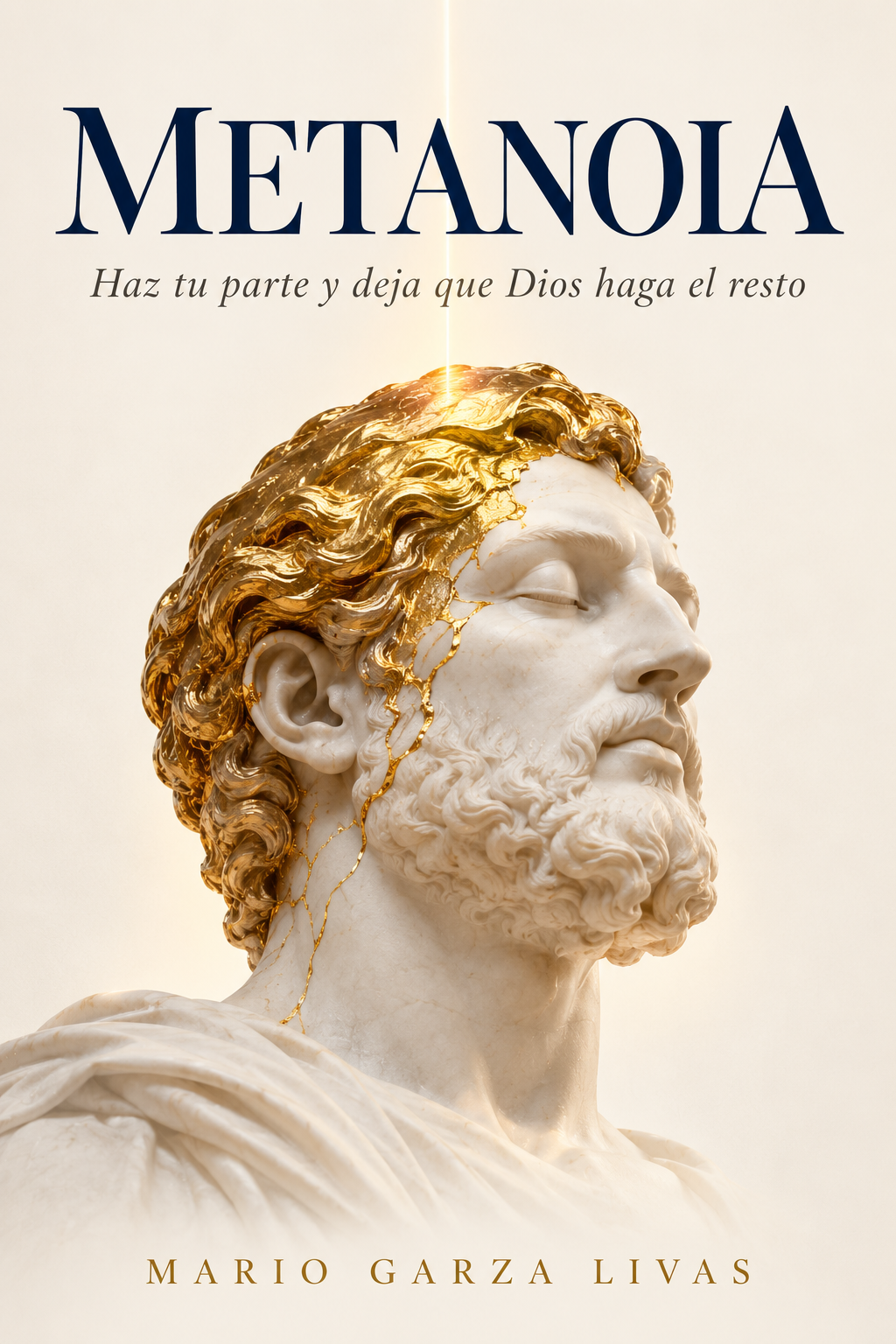
Cover of Metanoia: Do Your Part and Let God Do the Rest, by Mario Garza Livas
The book behind this walkthrough

Metanoia: Do Your Part and Let God Do the Rest

The distinction between first-order and second-order metanoia comes from this book by Mario Garza Livas, which travels from the map to the center in three books and a hinge. Free PDF download, no registration. Spanish edition.

Download the book (PDF)
Click or tap the image to zoom in or out.