The Metanoia Group
Mission,Vision& Values.
The philosophical and operational foundation from which TMG exists — and from which every intervention draws its meaning.
The correct order that success does not guarantee — before disruption forces it.
We exist to give leaders, companies, and wealth the correct order that success does not guarantee — before disruption forces them to seek it under the worst possible conditions.
We do this by building complete architectures — not optimized parts — that simultaneously integrate the person who leads, the company they build, and the wealth they generate.
Because no one else is looking at the complete system.
TMG exists because disorder in life rarely lives inside a single part. It lives in the relationship between the parts. And that problem does not exist within any lane of specialization. It can only be seen — and resolved — from the complete system.
Our mission is to produce in the client what the name promises: metanoia — not better decisions within the same system, but a different system from which decisions are made. Not optimization. Reordering.
For those who are ready, that reordering reaches all the way to the root.
Ad Majorem Dei Gloriam.
Conceptual
A different generation of leaders in the Spanish-speaking world.
By 2040, TMG will have demonstrated that it is possible to build a generation of leaders who do not need to wait for collapse to get ordered. Leaders whose systems — personal, business, patrimonial — were designed for adversity before it arrived.
BHAG
500 leaders. One major adverse cycle. Zero structural collapses.
By 2040, TMG's intellectual corpus and fieldwork will have produced 500 leaders in the Spanish-speaking world whose systems survived at least one major adverse cycle without collapsing, and whose wealth systems crossed a generational transition with structural coherence.
One-liner
“We built systems that survived what no one could predict.”
That was the only thing that mattered.
TMG's vision toward 2040 does not mention competition. There is no reference to beating any firm. The criterion of success is not market position — it is the real impact on the people, companies, and wealth that TMG accompanied. Scale is not the goal. The quality of impact is.
These are not decorative principles. They are the operating premises that inform every intervention, every relationship, and every decision about what to accept and what to decline.
IArchitecture before opinionThe root value
TMG never gives advice. It builds systems. The difference is not semantic — it is structural. Advice depends on who gives it. An architecture works regardless of who inhabits it. In every vertical, every differentiator, every intervention, the question is never what should this client do? but how is the system designed from which this client decides?
IISkin in the game as a condition of credibilityScars, not credentials
TMG does not teach what it studied. It teaches what it lived. Mario restructured real debt. Founded and sold a real company. Managed his own capital in real adverse markets. Operated inside professional football with real consequences. TMG's credibility does not come from its credentials — it comes from its scars. This value imposes a standard: if you have not inhabited the territory, you have no authority to draw the map.
IIIThe complete system or nothingStructural allergy to partial optimization
TMG has a structural allergy to partial optimization. It does not intervene in parts. It does not improve departments. It does not solve isolated problems. The premise that runs through the entire corpus is always the same: fragility is not in the part. It is in the relationship between the parts. TMG exists to see what no lane expert can see.
IVAntifragility as design, not as attitudeChaos is the permanent condition
The environment is not going to improve. Chaos is not an episode — it is the permanent condition. TMG does not promise to protect its clients from disorder. It builds systems that benefit from it. This value explicitly rejects crisis management thinking — which assumes there is a normal state to return to. At TMG, adversity is the normal state for which systems are designed.
VContinuity as competitive advantageStructural compounding
Conventional consulting forgets. TMG accumulates. Every session compounds the previous one. Every decision informed by the accumulated context of all previous ones. This value — the structural compounding of knowledge — explains why TMG builds permanent intelligence infrastructure instead of project-based engagements. The relationship that ages well is the one that was designed to age.
VIPrecision over speedZero margin of error
TMG operates in environments where the margin of error is zero — professional football calibrated it that way. There is no draft version of error. No discreet correction. No second chance at a first impression before the market. This value manifests in TMG's insistence on stress-testing decisions before executing them, on diagnosing biases before commitment, on simulating consequences before capital is at risk.
VIIThe correct order exists — and can be foundThe most philosophical value
TMG is not relativist. It does not believe every client has their own truth or their own system. It believes there is a correct order for each system — and that the work consists of finding it, not inventing it. This applies to the company, to wealth, to leadership, and for clients who allow it, to the entire life. Disorder is not a preference. It is a design failure.
VIIIAd Majorem Dei GloriamThe source that is not announced
For those who recognize it, it is present in everything. Not as spiritual decoration. As operational foundation. The name itself — Metanoia — is radical transformation of mind, conversion of Greek origin and deeply theological. The motto — Structure stabilizes. Purpose directs. Adaptation sustains. — is a functional trinity. The transcendental dimension is not an optional service. It is the revelation of where Mario operates from within. This value is not introduced. It is not sold. It is only recognized.
PDF · Free download · Spanish
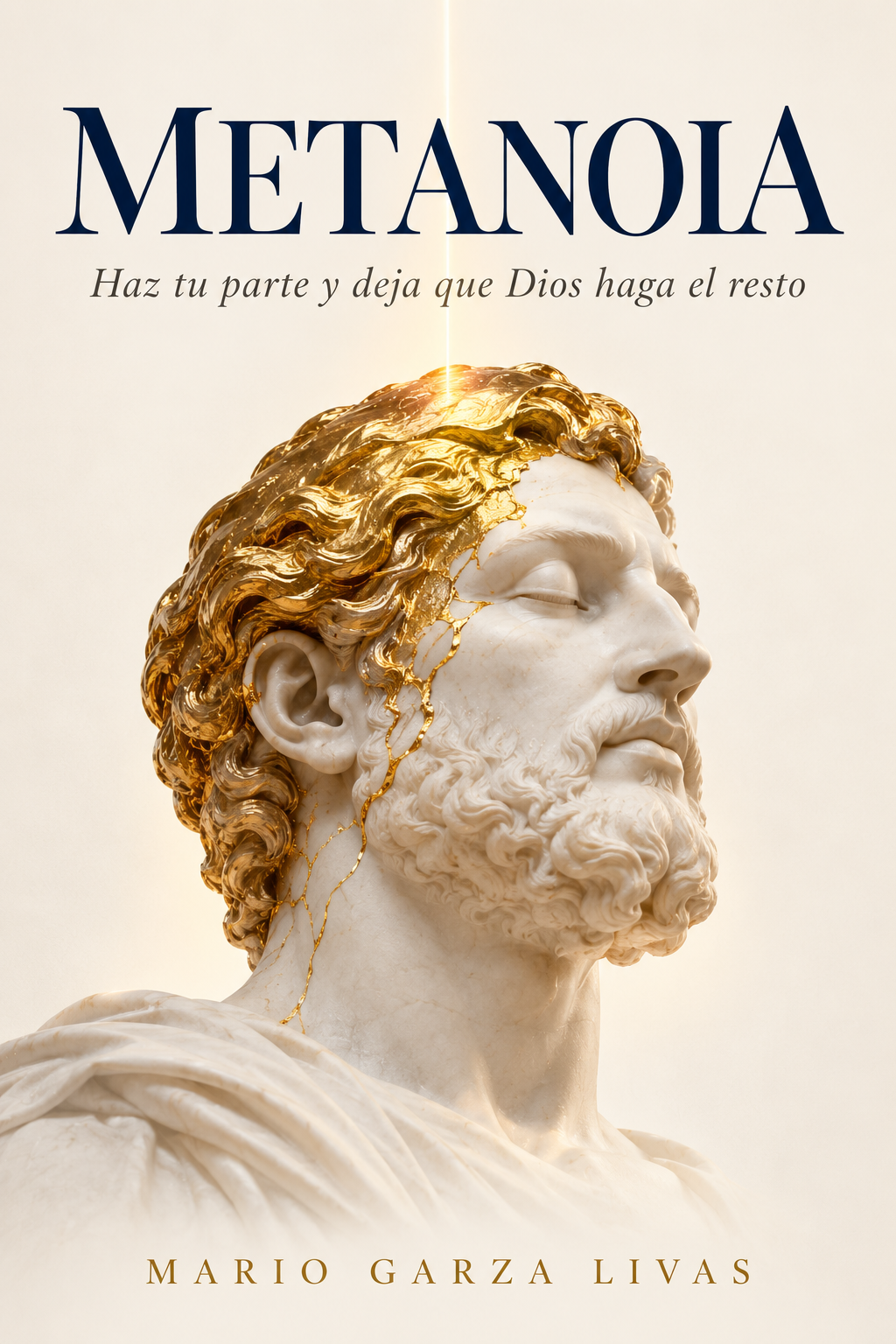
Metanoia. The book where it all began.
Do your best and let God do the rest.
Before it was a firm, The Metanoia Group was a book. Metanoia is not a biography, but it runs parallel to a real life story, and it sums up the philosophy and purpose from which TMG exists. What began as a project became a company and, in the end, a vocation.
Its thesis is demanding: a life can be extraordinarily well executed and still be badly oriented. The problem is not always that a person doesn't know how to work, decide, lead or build. It may be that they learned all of it without ever asking what for. The book starts from that fracture between capability and meaning.
The journey runs from the map to the center, and from the center to the mission. First it teaches how to read reality and how to tell apart what depends on you; then it acknowledges the limit of any system of control; finally it orders life from its foundation: GOD → BEING → DOING → HAVING. It is the same architecture TMG builds with every client — the person who leads, the company they build, the wealth it generates — with the root in plain sight.
It does not promise a life without loss, uncertainty or failure. It promises a way to go through them without losing the center.
The book is currently available in Spanish.
The first metanoia
Change the map.
Look at reality before deciding what you want it to be. Tell apart what you control, what you can influence and what does not depend on you. Hold a stable center with an adaptable configuration. It depends, to a large degree, on human decision.
The second metanoia
Change the center.
Recognize that you are not your own foundation: life is a gift before it is a project, and dignity comes before performance. That is why you can fail without being a failure. This transformation is received, and it requires cooperation.
You change the map; God changes the center. Do your part, and let Him do the rest.
The twelve rules
The whole journey condenses into twelve rules. They are not loose pieces of advice: they form a chain, and breaking any link produces a distortion.
- Look at reality before deciding what you want reality to be.
- Tell apart what you control, what you can influence and what does not depend on you.
- Hold a stable center and an adaptable configuration.
- Let virtue set the limits and the direction of your adaptation.
- Change the map when reality demands it.
- Don't mistake the result for your identity.
- Build for futures you cannot predict.
- Recognize that you are not your own foundation.
- Do your part fully and hand over what was never yours.
- Order your life from its center: God, Being, Doing, Having.
- Practice a rule of life.
- Always ask: for whom?
The metanoias, as graphic novels
Forty-two lives. Two ways to change.
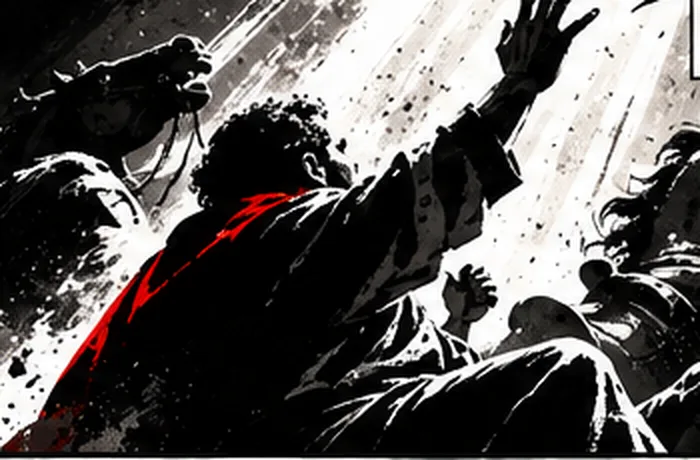
From Marcus Aurelius to Steve Jobs, from Moses to Carlo Acutis: a guided walkthrough through the lives of remarkable people who changed the map, or received a new center. Each story fits on a single page.
 First order
 Second order
Metanoia is part of a body of work of dozens of books. Mario Garza Livas's complete work is gathered in one place, free to download.
Why the flame
The bush that burns without being consumed.
“The angel of the Lord appeared to him in a flame of fire out of the midst of a bush. He looked, and the bush was burning, yet it was not consumed.”Exodus 3:2
Our symbol is not just any fire. Its tongues are shaped like leaves: it is the burning bush, the place where Moses encountered God.
A fugitive tending someone else’s flock came closer to look. He left with a mission that was not his own, but received.
IThe name
From that flame, God reveals who He is: “I AM WHO I AM” (Exodus 3:14). The Church contemplates in this passage the revelation of the divine name (Catechism, 203–213): the God who is, and from whom everything else receives its being.
IIThe word of Christ
The bush did not remain in the past. Jesus himself quotes it. When the Sadducees question him about the resurrection, he answers:
“Have you not read in the book of Moses, in the passage about the bush, how God said to him, ‘I am the God of Abraham, and the God of Isaac, and the God of Jacob’? He is not God of the dead, but of the living.”Mark 12:26-27
It is a passage that Christ himself chose to teach.
IIIThe Incarnation
The Fathers of the Church saw in the bush the mystery of the Incarnation: divinity united to humanity without consuming it. The fire of God dwells in the flesh without destroying it. That is Christ.
IVMary
The Church also recognizes in the bush a figure of the Virgin Mary, who carried God in her womb and remained a virgin. In the octave of Christmas, the liturgy sings it this way:
“In the bush that Moses saw burning yet unconsumed, we recognize your wondrous virginity preserved, holy Mother of God.”Antiphon at Lauds · January 1
The Eastern tradition even venerates a Marian icon by that name: The Burning Bush.
VPentecost
And the fire did not go out. The same fire Moses saw in the bush descends upon the apostles in tongues of fire (Acts 2:3). That day, Peter calls everyone to conversion: “Repent” —in Greek, metanoēsate— (Acts 2:38).
Our symbol does not remain in the Old Testament: it is born there, and fulfilled in the New.
Our symbol is the bush, not the cross. But the bush, like all of Scripture, leads to Christ.
That is metanoia. Not improving who you already are, but being transformed at the source.
And it is the fire we seek to kindle in every leader: one that does not wear down the one who carries it. It burns. It transforms. It does not consume.
“Remove the sandals from your feet, for the place on which you are standing is holy ground.”Exodus 3:5
Ad Majorem Dei Gloriam.